
Phoenix HVAC Brand Decision Guide • Updated for 2026 • Cold Stinger Heating & Air Conditioning
HVAC Brands to Avoid in Phoenix (and the Best AC Brands for Arizona Heat)
If you’re searching for HVAC brands to avoid, you’re really trying to avoid three things: downtime in extreme heat, expensive repairs, and warranty headaches. This page covers the full decision: brands to avoid (and why), reliable brands for hot climates, budget tiers, Phoenix heat performance, installer-sensitive brands, and what matters more than brand (sizing + install + ducts).
Quick Answer: Which AC Brands Should You Avoid?
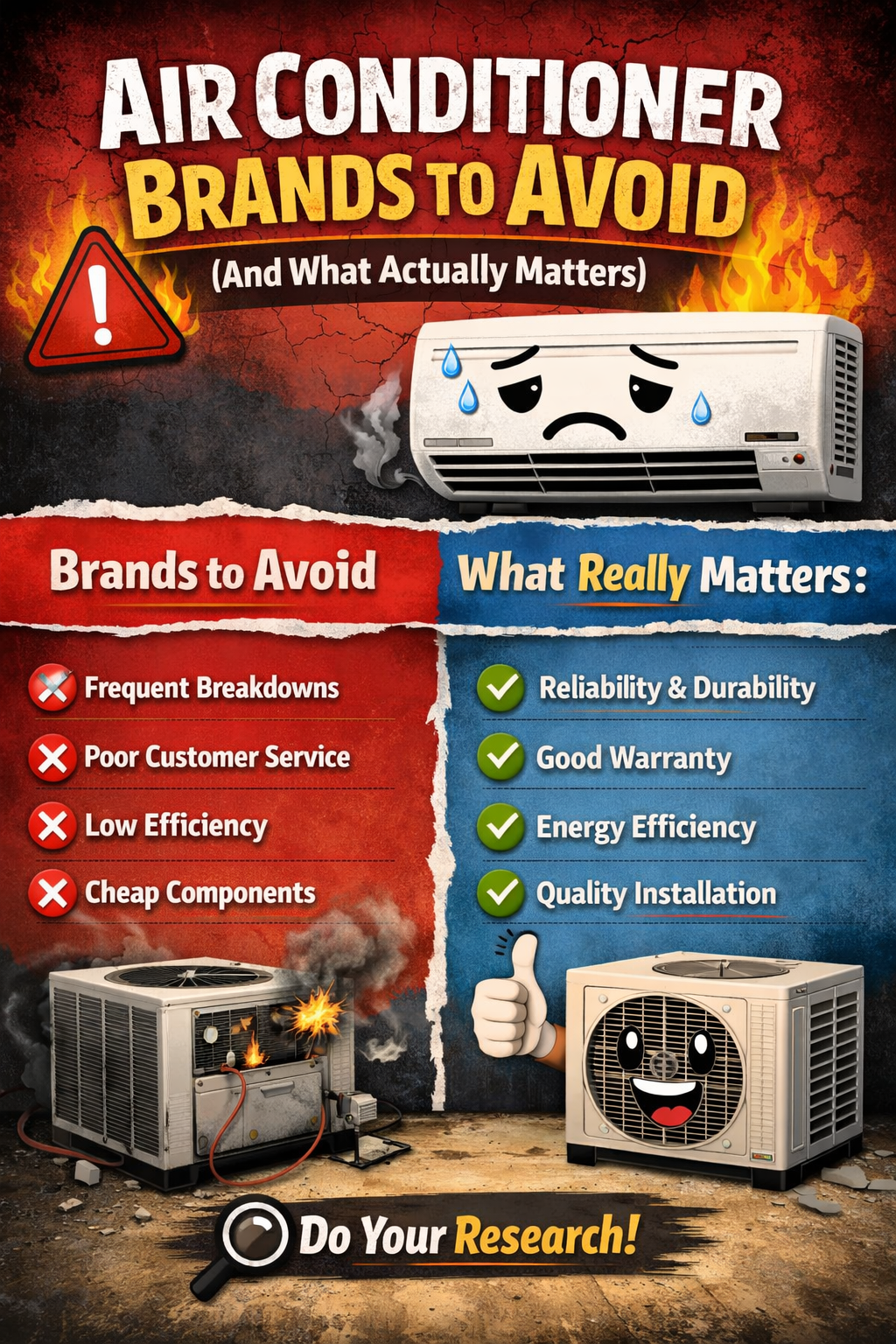
Homeowners should avoid focusing on AC brands alone. Most complaints about “bad brands” are caused by poor installation, improper sizing, or duct issues — not the equipment itself. That said, some brands have higher repair frequency, limited dealer support, or poor performance in extreme heat when installed incorrectly.
On this page (jump links)
Air Conditioner Brands to Avoid (And Why)
Let’s be precise: most homeowners are not trying to avoid a logo — they’re trying to avoid breakdowns during peak heat and repairs that take too long. In Phoenix, the “worst AC brand” is often the one that leaves you waiting on parts or dealer support in July.
Practical “avoid” categories (Phoenix-focused)
| Category to be cautious with | Why homeowners struggle | Phoenix impact |
|---|---|---|
| Ultra-cheap / off-brand systems | Inconsistent quality control, weaker parts support, short dealer networks | Higher chance of mid-summer failure + longer downtime |
| Online-only brands | Parts delays, limited local warranty ecosystem, fewer trained techs | Repairs can stall for days when you need cooling most |
| Models with frequent parts backorders | Even a “good” brand becomes a problem if key parts aren’t available quickly | Extended discomfort + risk of heat-related issues inside the home |
| Install-sensitive units paired with bad ductwork | Variable-speed / high-efficiency equipment can expose airflow problems | Hot rooms, coil freeze-ups, noise, high bills, short cycling |
If you want a direct “should I avoid X brand?” answer: keep reading — we cover installer-dependent brands, Phoenix-heat performance, and common brand regret scenarios.
What Makes an HVAC Brand “Bad” vs “Good”
The best way to choose a brand is to stop thinking in absolutes (“best” / “worst”) and evaluate what actually changes outcomes in Arizona: serviceability, parts availability, heat durability, and how forgiving the equipment is when the home’s duct system isn’t perfect.
Signals of a “good” brand choice (in Phoenix)
- Strong local support: lots of trained technicians + common parts in circulation
- Service-friendly design: faster diagnostics and repairs
- Proven compressor platforms: predictable performance under long run times
- Clear warranty process: fewer “paperwork traps” and smoother claims
- Compatible with your home: correct sizing + airflow capacity + return duct design
Signals of a “bad” fit (even if the brand is popular)
- Dealer scarcity: only a few companies can service it quickly
- Parts delays: long waits for boards, motors, sensors, or coils
- Airflow mismatch: unit needs more airflow than the duct system can deliver
- Oversizing pressure: “bigger is better” leads to short cycling + comfort issues
- No commissioning: install skips airflow/static checks + correct charge verification
This is why two homeowners can buy the “same brand” and have opposite experiences. In Phoenix, reliability is a system outcome: equipment + sizing + ductwork + install quality + start-up testing.
Most Reliable AC Brands for Arizona Heat
If your goal is long-term reliability in a hot climate, prioritize brands and model lines that have: (1) strong local support, (2) proven track records under long duty cycles, and (3) easy serviceability.
| Brand | Strengths | Weaknesses | Best for |
|---|---|---|---|
| Trane (and related lines) | Build quality, strong comfort options, good long-term ownership fit | Higher upfront cost; premium parts/labor can cost more | Long-term homes, owners who want durability + comfort |
| Carrier (and related lines) | Broad lineup, widely serviced, strong dealer ecosystem | Model-to-model differences matter; avoid “buying blind” | Balanced choice when paired with a strong install scope |
| Lennox | High efficiency options, comfort-focused features | Parts availability can vary by season/market; plan for support | Energy savings goals + comfort upgrades (done correctly) |
| Rheem / Ruud | Solid reliability/value mix, common parts footprint | Like all brands, install quality still decides outcomes | Value-minded reliability with good local support |
| Daikin / Goodman / Amana | Budget-to-midrange pricing, widely available | More install-sensitive; performance varies heavily by contractor | Budget installs when airflow/ductwork is handled properly |
Want a faster path to the right tier? Jump to Best AC Brands by Budget Tier or Brands That Depend on Installer Quality.
Best AC Brands by Budget Tier
Most homeowners don’t need “the best brand.” They need the best total system outcome for their budget. Here’s how to think about it in tiers without getting trapped by brand-only decisions.
Budget tier (value-first, still reliable)
The goal here is: dependable cooling + serviceability with a contractor who verifies airflow and charge.
- Prioritize: strong local support + simple, proven configurations
- Avoid: online-only / ultra-cheap off-brands with weak parts networks
- Best fit: rentals, short-to-mid ownership, tight budgets
Mid tier (best overall ROI for Phoenix)
This is where many Phoenix homeowners land: better comfort + efficiency without paying for every premium feature.
- Prioritize: 2-stage options, proven platforms, measurable commissioning
- Ask for: load sizing + static pressure/airflow verification
- Best fit: most owner-occupied homes planning to stay 5–10+ years
Premium tier (comfort + quiet + long run time)
Premium systems can be worth it in Phoenix if you want quieter operation, better temperature balance, and longer run times at lower output. But premium equipment is also less forgiving if your ducts/returns are undersized.
- Prioritize: a contractor who tests and documents the install (airflow/static/charge)
- Best fit: long-term homeowners who value comfort and plan to keep the system 12–20 years
- Big warning: don’t pay premium prices if the duct system can’t support the airflow
Brands That Depend on Installer Quality
This is where most “bad brand” stories come from. Many mainstream brands can be excellent — but some are more installation-sensitive. If sizing, airflow, duct sealing, or refrigerant charge is off, you can get: hot rooms, high bills, noise, repeated breakdowns, or reduced system life.
| Brand category | Why it’s installer-sensitive | What must be done right |
|---|---|---|
| Value brands (budget-friendly) | Performance varies widely based on airflow/duct quality; installs get “rushed” more often | Correct sizing, correct airflow, correct charge, proper drain/condensate setup |
| High-efficiency / variable-speed | These systems expose duct restrictions and static pressure problems quickly | Static pressure testing, duct corrections, return capacity, proper commissioning |
| Any brand with limited local support | If fewer techs/service centers support it, warranty and repairs slow down | Choose equipment with strong dealer footprint + stocked parts in the Valley |
AC Brands That Perform Poorly in Phoenix Heat
Phoenix heat doesn’t “punish brands” — it punishes weak system design. The same model can perform great in one home and fail early in another if: it’s undersized, airflow is restricted, ducts leak into an attic, or the unit is charged incorrectly.
What fails first in Phoenix heat (most common)
- Capacitors and electrical components (heat + long run time)
- Compressors (often due to airflow/charge issues or repeated stress)
- Condenser fan motors (continuous high-temp operation)
- Evaporator coil issues (airflow restrictions, dirty filters, duct problems, icing)
The real “Phoenix heat” avoid list
Avoid any option that creates long downtime or chronic stress: off-brand systems with weak parts networks, online-only units, or premium variable-speed equipment installed on a duct system that can’t support it.
If your home has hot rooms, weak airflow, or high bills, start here: Air Conditioner Not Cooling and consider a duct/airflow review before buying “a better brand.”
Are Expensive AC Brands Worth It?
Sometimes — but only when the rest of the system can support what you’re paying for. Premium brands and premium model lines usually buy you: better comfort (longer low-output run time), lower noise, and higher efficiency. In Phoenix, higher efficiency can help because AC runs hard for months.
Worth it when…
- You plan to stay in the home long-term
- You want quieter operation + fewer temperature swings
- Ductwork/returns are sized correctly (or you’ll fix them)
- The contractor will commission and document the install
Not worth it when…
- Your ducts are undersized/restricted and won’t be corrected
- The quote is a “swap” with no airflow/static testing
- You’re paying premium for features you won’t notice in your home
- Local parts support is weak (downtime risk)
Want pricing ranges that match Phoenix reality? Use: AC Replacement Cost in Phoenix or the broader HVAC Costs hub.
AC Brand Problems Homeowners Regret
When homeowners regret a brand choice, it’s usually not because the brand is “trash.” It’s because the decision was made without matching the equipment to the home and the installer’s scope. Here are the most common regret patterns we see in Phoenix.
| Regret | What caused it | How to avoid it |
|---|---|---|
| “I bought a top brand and still have hot rooms.” | Duct restrictions, undersized returns, high static pressure, poor balancing | Airflow/static pressure testing + duct corrections before/with install |
| “It keeps breaking down — must be the brand.” | Oversized system short-cycling, incorrect charge, weak commissioning | Manual sizing + start-up testing + verified charge and airflow |
| “Warranty didn’t cover what I expected.” | Registration/documentation issues, install details not compliant | Register warranty, keep paperwork, choose contractor with clean process |
| “Parts take forever.” | Low dealer density, uncommon parts footprint, seasonal backorders | Choose brands/models with strong Valley support + common parts access |
What Matters More Than Brand (Sizing, Install, Ducts)
If you only remember one section on this page, make it this one. These factors decide whether your system lasts 12 years or 20 years — and whether your home is comfortable in August.
1) Correct sizing (load) beats brand
Oversized systems short cycle (wear + humidity/comfort issues). Undersized systems run nonstop and still can’t keep up. In Phoenix, sizing must match desert heat conditions and the home’s duct capacity.
Related: AC Installation / Replacement
2) Airflow + ducts decide comfort
If returns are restricted or ducts leak into an attic, even the “best brand” struggles. Airflow issues drive coil icing, noisy operation, high bills, and chronic failures.
Symptom-first help: Air Not Cooling
3) Installation quality (commissioning) is the difference-maker
- Refrigerant charge verified (not guessed)
- Airflow/static pressure checked (and corrected if needed)
- Electrical protections installed correctly
- Drain/condensate set up to prevent water damage and stoppages
- Thermostat setup matched to staging/variable-speed behavior
If you need help fast: AC Repair in Phoenix • For replacement: AC Installation / Replacement
FAQs About AC Brands (Consumer Reports, Reliability)
What are the most reliable AC brands for Phoenix heat?
Does brand matter in HVAC, or is it all about the installer?
Is Trane better than Carrier (or Lennox vs Trane vs Carrier)?
Should I avoid Goodman AC?
What AC brands break down the most?
Are “Consumer Reports” AC brand rankings enough to decide?
How long should an AC system last in Phoenix?
Repair or replace: how do I decide quickly?
Related pages (recommended next steps)
- AC Services (Phoenix) — repair, replacement, tune-ups, emergency help
- AC Installation / Replacement — what to expect + quoting
- AC Repair in Phoenix — fast diagnosis + repair-first options
- HVAC Costs — pricing guides and budgeting
- AC Replacement Cost in Phoenix — installed ranges + what drives cost