
Buying Guide • Brand Reputation • Installation Quality
Which Air Conditioner Brands Should You Avoid?
Short answer: There are very few AC brands you should avoid outright — but there are situations where the wrong brand (or the wrong installer) can cost you thousands.
Best takeaway: Focus on sizing + installation quality first. A “premium” brand installed wrong will fail faster than a budget system installed right.
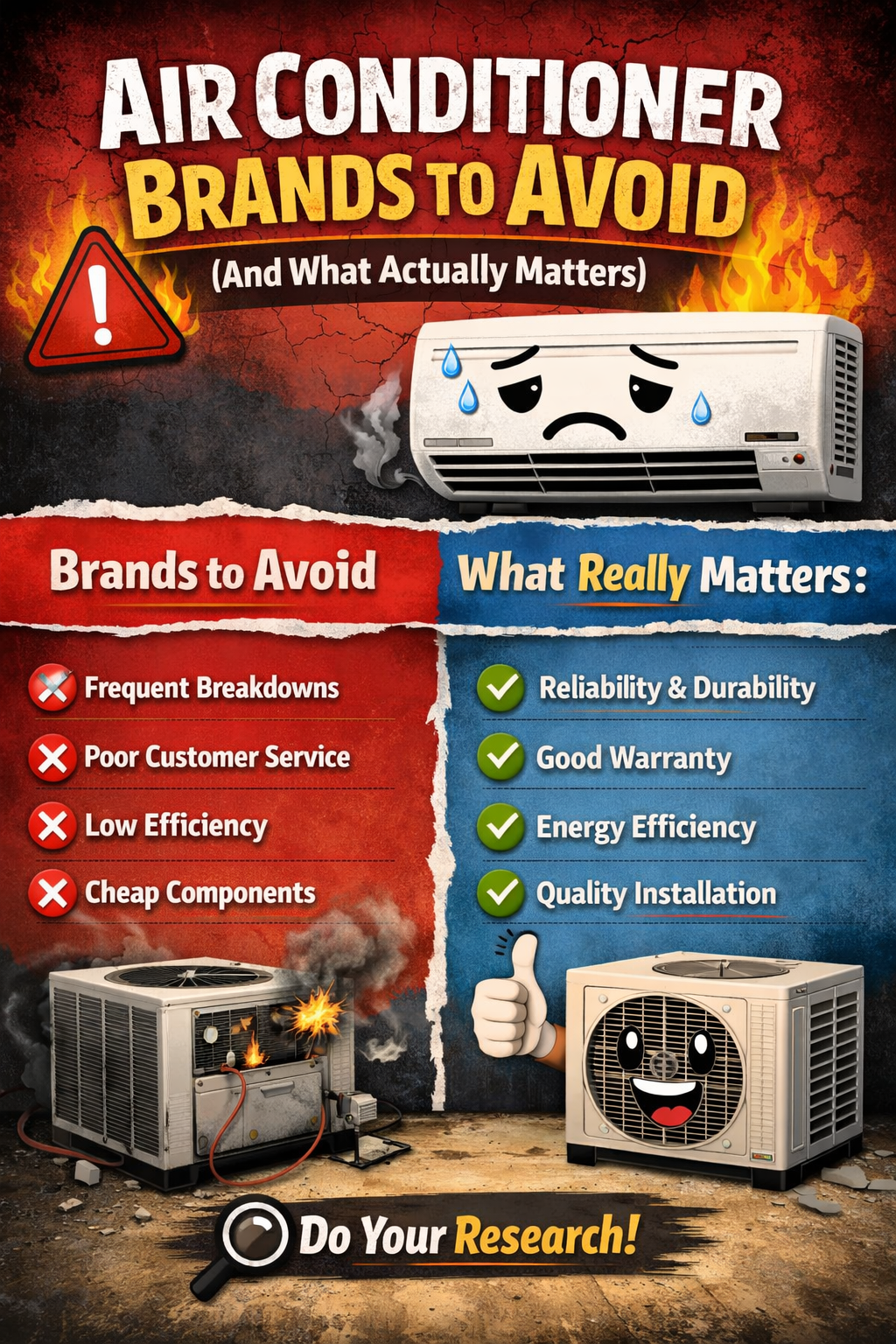
The Real Truth About Air Conditioner Brands
Many homeowners search for the air conditioner brands to avoid assuming some systems are inherently “bad.” In reality, most residential AC brands are mechanically similar. What matters far more than the brand name is:
- Correct system sizing (Manual J load calculation)
- Installation quality (refrigerant charge, evacuation, electrical, condensate, startup)
- Ductwork design + airflow (static pressure, returns, supply balance)
- Local climate compatibility (Phoenix heat demands strong airflow and correct capacity)
Bottom line: a premium brand installed incorrectly will underperform and break down sooner than a value brand installed correctly.
Does the Air Conditioner Brand Really Matter?
Not nearly as much as most people think.
Modern air conditioners are often built using shared components, and many “different” brands are actually produced by the same parent manufacturers.
Brand matters some for:
- Warranty structure and how claims are handled
- Dealer network support and parts availability
- Premium features (variable speed, communicating controls)
But the biggest performance drivers are still sizing, airflow, and workmanship.
Many AC Brands Are the Same System in Disguise
Here’s the key idea: two different logos can represent the same manufacturer family — and often very similar engineering.
| Parent Manufacturer | Brands Produced |
|---|---|
| Carrier | Carrier, Bryant, Payne, Comfortmaker, Heil, Day & Night, Tempstar |
| Trane | Trane, American Standard, RunTru |
| Daikin Group | Daikin, Goodman, Amana |
| Rheem | Rheem, Ruud |
| Johnson Controls | York, Coleman, Luxaire |
Because of this, buying a “cheaper brand” does not automatically mean you’re buying a fundamentally inferior air conditioner.
Why Some Air Conditioner Brands Cost Less
Lower-priced AC brands usually differ in:
- Fewer comfort features (single-stage vs. two-stage/variable speed)
- Lower efficiency (SEER2 rating)
- Simpler controls (non-communicating systems)
- Different warranty terms or dealer programs
This does not automatically mean a lower-priced unit is unreliable — it often just means it’s designed for a different budget and feature set.
Why Some AC Brands Have a Bad Reputation
Most negative brand reputations come from installation outcomes, not defective equipment.
Common causes include:
- Oversized systems that short-cycle, causing humidity issues and early wear
- Improper refrigerant charging and poor evacuation practices
- Bad duct design that starves airflow and raises static pressure
- Inexperienced installers and rushed startups
Unfortunately, the brand gets blamed for contractor mistakes.
So… Are There Any Air Conditioner Brands You Should Avoid?
Generally, no. There is no single residential AC brand that is universally “bad.”
What you should avoid instead:
- Contractors who skip a Manual J load calculation
- Extremely low bids that cut corners on materials or labor
- One-size-fits-all system recommendations
- Installers who don’t discuss ductwork, airflow, or static pressure
What Actually Determines AC Performance
If you want an air conditioner that lasts, stays efficient, and keeps your home comfortable, focus on:
- Proper sizing (capacity matched to your home)
- Airflow + ductwork (balanced supply/return, correct static pressure)
- High-quality installation (charge, evacuation, drainage, electrical)
- Maintenance (filters, coils, drain, refrigerant checks as needed)
The right contractor matters more than the logo on the unit.
FAQs: Air Conditioner Brands to Avoid
Are there any air conditioner brands you should avoid completely?
Usually no. Most brands can perform well when properly sized and installed. The biggest “avoid” is skipping the load calculation and cutting corners on airflow and installation quality.
Why do some AC brands have a bad reputation?
Because the installer matters. Oversizing, poor ductwork, and incorrect refrigerant charge can cause problems that homeowners blame on the brand.
Does AC brand matter at all?
Yes, but mostly for warranty terms, dealer support, and premium features. For comfort and lifespan, installation quality and airflow typically matter more.